
The Basketball Kid Takes a Stand
(continued from Wayne Rollins)
Episode Three: The Rise of The Basketball Kid
One day in November 1979, my winless 7th grade basketball team was off to another slow start in some opponent’s cold, near-empty gym. Early in the game there was an inbounds play at midcourt. The ref handed my teammate Chris the ball and Chris slapped it with his right hand, a signal to the rest of us to start milling around, pretending we had set plays. In a rare burst of on-court assertiveness, I cut hard to my left, breaking free of the listless scrum of bodies near the center jump circle. I caught the inbounds pass in stride and started dribbling toward the wide-open hoop. I had never scored a basket before, so as I dribbled a kind of joy bubbled up through my ribcage and into my throat.
Previous to that moment there had only been an aimless murmur of voices in the gym. Suddenly the murmur spiked, went weird. I’d never heard the sound before and hope to never hear it again: A generalized, ingrown gasp, like a note from a choir on a record played backwards. I pressed onward, dribbling, still preposterously open, ignoring.
I stopped just inside the foul line and hoisted the side-holstered push shot that all kids use before they get the hang of a real jump shot. Improbably, the basketball grazed the inside of the rim and nestled through the net. The strange sound that had risen up all around me ceased. I turned, smiling, expecting to see my teammates smiling back. Jesus, the look on their faces. My own smile congealed. The players on the other team stared one more beat, still stunned, then started spasming with laughter. Eventually the scoreboard operator added the tally to the already swollen number beneath the word HOME.
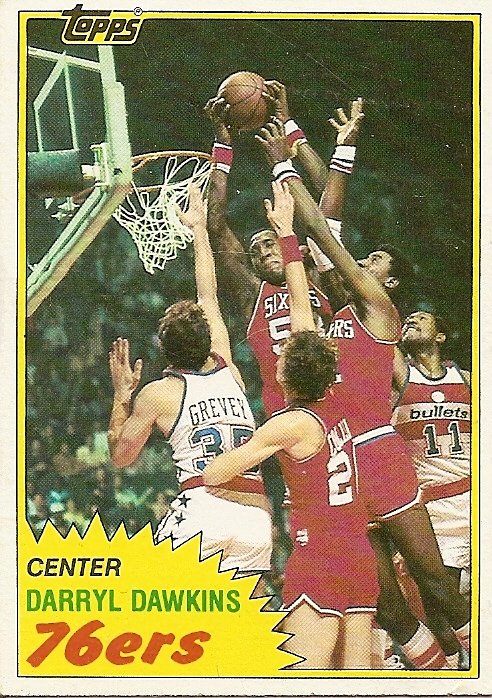
From that point on the losses began to blur together. We lost all our games that season, all but three the next season. By the time I got this Darryl Dawkins portrait in my last unironically purchased pack of trading cards I had begun to understand that my fate was sealed. Forever would I labor beneath scoreboards generating nauseating inequalities. Ninth grade was no different. Our freshman team lost every game. The following year my junior varsity team kept losing. The varsity coach, Viens, came into our locker room at halftime of a game we were losing pretty badly. He went down the line of all the guys on the team from my grade, listing faults, his mole-like face pinched into a particularly sour expression of pure disgust. Only two of us had been playing all along, since 7th grade. Me and Chris. Viens saved us for last.
“Wilker, I don’t notice you out there,” he said. “You’re invisible.”
“Chris,” he said. “You’re stupid.”
Chris had always been my mom’s favorite player. He was always the smallest kid on the court, and though he was something of a gunner, he always tried hard. Sometimes he tried so hard during our collective humiliations his face got red and he verged on tears, his unceasing drives into the crowded lane sometimes seeming like involuntary convulsions of grief. But Chris quit hoops at the end of that year, neglecting to try out to play for Viens on the varsity, and I wandered away to the boarding school that would eventually expel me. The summer after I got expelled I went to live with my grandfather, who had for the benefit of my brother and me nailed a backboard and a basketball hoop to a tree. The rim was the most forgiving rim in the history of the world. Almost any shot would fall dead upon contact with that rim and drop through the net as if collapsing from exhaustion. What was I going to do with my life? Who was I going to be? I avoided these questions. Instead, I went on outlandish imaginary scoring sprees, again and again, pretending I was someone else, some beleaguered, limping, indomitable hero battling long odds to lead his loyal teammates to victory. As had happened throughout my solitary childhood, sounds escaped my mouth as I played, the whispered approximations of crowd noises and ecstatic announcers and grateful exulting teammates. I was 17 years old. Finally my grandfather got me a job pumping gas. But I still got two days off a week, and I spent them the same way I’d been spending my free time before the start of my first full-time job. Reeking of pot smoke, hoisting jump shots, mumbling to myself, I imagined myself invisible to this world, instead forever rising in the universe within the universe where losses turn to wins.
continued in Mike Newlin


 Cardboard Gods
You must be logged in to post a comment.