
 “For six long years I’ve been in trouble
No pleasure here on earth I’ve found
For in this world I’m bound to travel
I have no friends to help me now”
— “Man of Constant Sorrow” (traditional)
On October 22, 1974, the San Francisco Giants sent the greatest of all the Next Willie Mayses to the New York Yankees for the greatest of all the Next Mickey Mantles. Beyond being perhaps the most even high-profile trade in baseball history (the players involved have been ranked by Bill James as the 15th and 17th best players ever to play their position), it also put an end once and for all to the hopes of each team’s hometown fans that the hype might actually come true. Most overinflated expectations of this kind fizzle quickly, laughably, but in each of these cases they had persisted for years, their lofty realization seeming many times to be just around the next bend. Each player kept verging on greatness. The greatest of all the Next Willie Mayses was fast and strong, the most exciting mix of power and speed to come into the game since the First Willie Mays, and the graceful, explosive batting swing of the greatest of all the Next Mickey Mantles made it too easy to dream that the Mick had yet to limp off the field for the last time. But by 1974, with neither team winning, I guess each franchise just decided they had waited long enough for immortal lightning to strike twice.
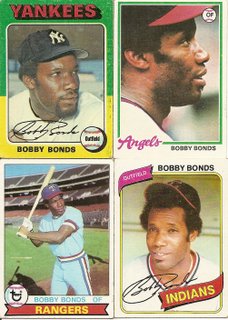
The trade broke the spell. Though Bobby Murcer and Bobby Bonds both continued to be among the best players in the game for a few more years, nobody persisted in thinking they were on the brink of becoming iconic, inimitable superstars. Murcer’s post-trade career had a slight air of ennobled melancholy to it, Murcer the Yankee-at-heart in cold, windy exile in San Francisco and Chicago, Murcer the aging part-time slugger returning home to the Yankees in 1979, once again too late for a recent string of championships, just as he had been when his first tour with the Yankees had begun in 1965. As for Bobby Bonds, his post-trade career can be summarized by the collage of cards shown here. In this world he’s bound to travel.
He lasted in New York for one season, many Yankee fans belittling him not because he wasn’t Willie Mays but because he wasn’t Bobby Murcer. In 1975 he was traded to the California Angels, who then traded him to the Chicago White Sox, who then traded him to the Texas Rangers, who then traded him to the Cleveland Indians, who then traded him to the St. Louis Cardinals, who released him, allowing him to sign with the Texas Rangers, who then sold him to the Chicago Cubs, who released him, which allowed him to sign with the New York Yankees, who released him a month later, on July 21, 1982, without using him once, the wayfaring slugger’s ninth and last major upheaval in seven and a half years since the sad and beautiful trade of the two Almost Greats.


 Cardboard Gods
You must be logged in to post a comment.