
Pregame notes: When I was a kid I was always looking for a way to dissolve into made-up worlds. That I never tried “Play Ball,” which was part of the back of each 1978 Topps baseball card, doesn’t reflect well on the game. If an isolated, day-dreaming, baseball-loving, baseball-card-collecting kid didn’t play the game, who the hell would?
But in retrospect I applaud the inclusion of the game, as it suggested that the cards were not to be sealed under protective plastic—a trend that took hold on a widespread basis after my years of collecting—but to be touched and handled and played with.
So I’ll play. Thirty years later, I’ll play.
Below are the rules, courtesy of one of the 1978 cards previously profiled on Cardboard Gods. (Pregame Trivia Question: Can you name the player featured on the rule-giving card?)
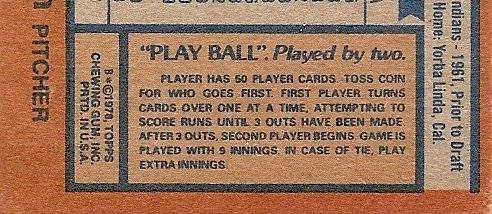
I will be breaking the primary rule (“Played by two”) by playing solitaire. I will also ignore the coin toss rule. I know which of my imaginary teams is the home team and don’t need a coin toss to tell me.
I will describe the action in a running line-score below. The outcome of each at-bat is followed by the parenthetical listing of the player whose card provided the outcome. I think it’s important to keep in mind when perusing the results below that the players listed are not participants in the imagined game but the gods that determine the path of that game. The cards are all 1978 cards that have been profiled on Cardboard Gods; the earlier cards have been jostled from their chronological order and appear randomly (some time ago when I was leafing through my stack of written-about cards I dropped them and they scattered all over the floor), while the more recent ones were pulled from the pile in the order they appeared on this site.
Now, with all that out of the way, please rise for the singing of This Land Is Your Land.
Thank you. Play Ball!
Top of First, Hate Batting, Tied 0-0
1. Base on Balls (Wilbur Wood), runner on first.
2. Strikeout (Willie Stargell)
3. Single (Jim Rice), runners on first and second.
4. Ground Out (George Foster), double play.
0 run, 1 hit, 0 errors, 1 LOB. Hate 0, Love 0.
Bottom of First, Love Batting, Tied 0-0
1. Triple (Pete LaCock)
2. Double (Lenny Randle), run scores
3. Fly Out (Bo McLaughlin)
4. Single (Bill Buckner), run scores
5. Strikeout (Rich Dauer)
6. Ground Out (Dale Murray)
2 runs, 3 hits, 0 errors, 1 LOB. Hate 0, Love 2.
First inning notes: I want to talk about the team names, but first let me say how pleased I am that the trio of gods delivering the first runs of the game for Love are Pete LaCock, Lenny Randle, and Bill Buckner. Who better? Anyway, when I was a kid my made-up games often involved the development of entire leagues populated by teams filled with individual personalities. But occasionally I kept it simpler. I once spent hours playing handball in our living room with a balloon, and I never developed the imagined entities in opposition to one another beyond “left hand versus right hand.” I based the naming of the two teams battling it out in my enactment of “Play Ball” on that lackluster afternoon’s battle between hands and on the memorable monologues on the very same battle by the Robert Mitchum character in Night of the Hunter and Radio Raheem in Do the Right Thing. Here’s the latter character’s version of the speech:
Let me tell you the story of “Right Hand, Left Hand.” It’s a tale of good and evil. Hate: It was with this hand that Cain iced his brother. Love: These five fingers, they go straight to the soul of man. The right hand: the hand of love. The story of life is this: Static. One hand is always fighting the other hand; and the left hand is kicking much ass. I mean, it looks like the right hand, Love, is finished. But, hold on, stop the presses, the right hand is coming back. Yeah, he got the left hand on the ropes, now, that’s right. Ooh, it’s the devastating right and Hate is hurt, he’s down. Left-Hand Hate K.O.ed by Love.
Top of Second, Hate Batting, Behind 0-2
5. Single (Bobby Bonds), runner on first
6. Home run (Garry Templeton), two runs score
7. Fly Out (J.R. Richard)
8. Fly Out (Lyman Bostock)
9. Fly Out (Mario Guerrerro)
2 runs, 2 hits, 0 errors, 0 LOB. Hate 2, Love 2.
Bottom of Second, Love Batting, Tied 2-2
7. Fly Out (Bob Bailor)
8. Strikeout (Grant Jackson)
9. Double (Dave Johnson), runner on second
1. Base on Balls (Rollie Fingers), runners on first and second
2. Fly Out (Paul Lindblad)
0 runs, 1 hit, 0 errors, 2 LOB. Hate 2, Love 2.
Second inning notes: One of the problems you notice immediately with “Play Ball” is that there is no guidance on even the most simple shadings of the game of baseball. For example, if there is a runner on first and the next card displays “Ground Out,” is the “Ground Out” a double play? Similarly, if there is a runner on first and the next card is a “Single,” does the runner on first advance to second or to third? I briefly considered introducing some sort of random-choice device into the game to decide on these matters, but nowhere in the rules of “Play Ball” does it suggest that such alterations be made. Besides, if the playing of this game is in part a tribute to all the many hours I spent as a kid playing made-up games, I should just handle this issue the way I would have handled it then—by nudging every close call toward the team I wanted to win. In my favorite game, backyard roofball, this practice manifested itself on certain long ricochets of the tennis ball off the ridged roof. If the “player” pursuing the drive was a member of the team I wanted to win (generally a collection of gutty, limping has-beens and never-weres who were staging an improbable last-chance drive toward glory) I would run as hard as possible and even dive; if the “player” was on the opposition (generally a conglomerate of chiseled automatons with a collective history of monotonous and featureless league domination) I’d maybe hope the ball would tick off my fingers for a thrilling, game-changing triple. The funny thing is, I probably made as many if not more tough catches when I wasn’t trying than when I was, and anyway I never wanted to push things too far in favor of one imaginary team, knowing that in doing so I’d strip the whole time-consuming pursuit of the illusion of drama, and hence meaning. But for “Play Ball” I decided to keep it simple and make one rule to turn all gray areas black and white. At the risk of sounding trite, here it is: When in doubt, go with Love.
Top of Third, Hate Batting, Tied 2-2
1. Double (Davey Lopes), runner on second
2. Base on Balls (Johnny Oates), runners on first and second
3. Fly Out (Champ Summers)
4. Single (Sparky Lyle), runners on first, second, and third
5. Single (Darrell Evans), run scores
6. Fly Out (Tom Burgmeier)
7. Fly Out (Bob Stanley)
1 runs, 3 hits, 0 errors, 3 LOB. Hate 3, Love 2.
Bottom of Third, Love Batting, Behind 2-3
3. Strikeout (Sixto Lezcano)
4. Base on Balls (Skip Jutze)
5. Single (Greg Minton), runner on first
6. Fly Out (Mike Paxton)
7. Fly Out (Von Joshua)
0 runs, 1 hit, 0 errors, 1 LOB. Hate 3, Love 2.
Third inning notes: So Hate takes the lead, despite my rule making Hate into a plodding station-to-station team incapable of scoring from second on a single or from third on a flyout (or, as in the first inning, from avoiding the double play). Hate might win! But I’m already running out of previously profiled 1978 cards, and for some reason this actually makes me sort of hopeful. I’ve been writing about these cards for a year and a half, and the game isn’t even official. There’s plenty of Ball left to Play. Anything can happen. And maybe Love will get a hand from Gene Pentz, whose card provided the inspiration for this whole endeavor. Only a few more cards to go until I get to his card, the one card whose outcome I already know, Pentz ready to provide that node of offensive attack that is as vitally important as it is mundane. The walk! As we head to the fourth inning, let us pray for Pentz to plant the seeds of a rally for Love.
Top of Fourth, Hate Batting, Ahead 3-2
8. Ground Out (Joe Niekro)
9. Ground Out (Carl Yastrzemski)
1. Single (Stan Bahnsen), runner on first
2. Single (Ron Schueler), runners on first and second
3. Single (Brian Downing), run scores (note: even a Hate-handicapped station-to-station team will generally score from second on a two-out single), runners on first and third
4. Ground Out (Steve Garvey)
1 run, 3 hits, 2 LOB. Hate 4, Love 2
Bottom of Fourth, Love Batting, Behind 2-4
8. Base on Balls (Gene Pentz), runner on first
9. Foul Out (Barry Bonnell)
1. Base on Balls (Ivan DeJesus), runners on first and second
2. Ground Out (Jack Clark), runners on second and third
3. Home run (Jim Colborn), three runs score
4. Triple (Jerry Koosman), runner on third
5. Base on Balls (Brian Asselstine), runners on first and third
6. Fly Out (Chris Speier)
3 runs, 2 hits, 2 LOB. Love 5, Hate 4
Top of Fifth, Hate Batting, Behind 4-5
5. Foul Out (Steve Dunning)
6. Double (John Scott), runner on second
7. Fly Out (Lee Mazzilli), runner on second
8. Fly Out (Oscar Gamble)
0 runs, 1 hit, 1 LOB. Love 5, Hate 4
Bottom of Fifth, Love Batting, Ahead 5-4
7. Strikeout (Johnnie LeMaster)
8. Single (Bill Plummer), runner on first
9. Fly Out (Greg Gross), runner on first
1. Single (Freddie Patek), runners on first and second
2. Strikeout (Jerry Royster)
0 runs, 2 hits, 2 LOB. Love 5, Hate 4
Top of Sixth, Hate Batting, Behind 4-5
9. Ground Out (Tom Seaver)
1. Home run (Alan Ashby), one run scores
2. Foul Out (Lou Brock)
3. Ground out (George Brett)
1 run, 1 hit, 0 LOB. Love 5, Hate 5
Bottom of Sixth, Love Batting, Tied 5-5
3. Fly Out (Terry Bulling)
4. Single (Dave Skaggs), runner on first
5. Ground Out (Ed Figueroa), fielder’s choice, runner on second
6. Fly Out (Tommy Boggs)
0 runs, 1 hit, 1 LOB, Love 5, Hate 5
Top of Seventh, Hate Batting, Tied 5-5
4. Strikeout (Gary Beare)
5. Single (Ruppert Jones), runner on first
6. Fly Out (Lee Lacy), runner on first
7. Fly Out (Steve Staggs)
0 runs, 1 hit, 1 LOB, Love 5, Hate 5
Bottom of Seventh, Love Batting, Tied 5-5
7. Ground Out (Pete Redfern)
8. Fly Out (Bill Bonham)
9. Fly Out (Dave Cash)
0 runs, o hits, o LOB, Love 5, Hate 5
Top of Eighth, Hate Batting, Tied 5-5
8. Fly Out (Jim Dwyer)
9. Ground Out (Mario Soto)
1. Single (Jim Fregosi), runner on first
2. Base on Balls (Doug DeCinces), runners on first and second
3. Ground Out (Tom Veryzer)
0 runs, 1 hit, 2 LOB, Love 5, Hate 5
Bottom of Eight, Love Batting, Tied 5-5
1. Single (Enos Cabell), runner on first
2. Strikeout (Gil Flores), runner on first
3. Single (Phil Niekro), runners on first and second.
4. Foul Out (Dick Ruthven), runners on first and second.
5. Fly Out (Jeff Burroughs)
0 runs, 2 hits, 2 LOB, Love 5, Hate 5
Top of Ninth, Hate Batting, Tied 5-5
4. Ground Out (Andy Messersmith)
5. Base on Balls (Rod Gilbreath), runner on first
6. Single (Jamie Easterly), runners on first and second
7. Single (Biff Pocoroba), runners on first, second, and third
8. Single (Tom Paciorek), two runs score, runners on first and third
9. Foul Out (Rick Camp)
1. Base on Balls (Dave Campbell), runners on first, second, and third
2. Fly Out (Darrel Chaney)
2 runs, 3 hits, 3 LOB. Hate 7, Love 5
Bottom of Ninth, Love Batting, behind 5-7
6. Fly Out (Pat Rockett)
7. Double (Vic Correll), runner on second
8. Base On Balls (Buzz Capra), runners on first and second
9. Fly Out (Joe Nolan), runners on first and second
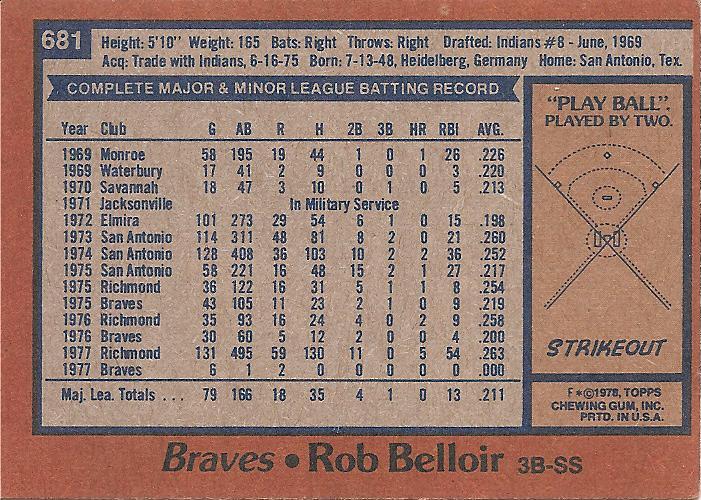
1. Strikeout (Rob Belloir), runners on first and second
0 runs, 1 hit, 2 LOB. Love 5, Hate 7


 Cardboard Gods
You must be logged in to post a comment.