
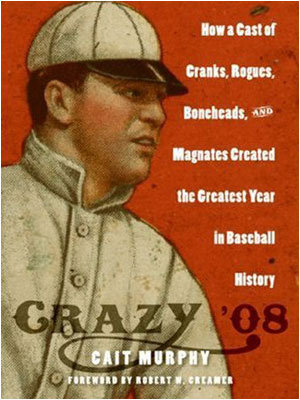
“Maybe it was just a ball game. But it didn’t feel that way.” – Cait Murphy, Crazy ’08
I was recently asked to name my ten favorite baseball books. Despite never veering from my lifelong habit of reading about baseball, my list has remained the same for quite some time, so I immediately rattled off what I thought was my impenetrable murderer’s row as if I was reciting the alphabet. I may as well have pounded my fist on a podium as I answered. My immortal list! It shall never change!
A few days later, I started reading Crazy ’08, Cait Murphy’s electrifying tale of the 1908 major league baseball season. The narrative of her insightful, irreverent, illuminating book barrels forward like a high-speed train through a wonderland—you want the train to slow down so you can study the wealth of details flying by, but you can’t help charging ahead to see what’s around the next corner. Even before I was finished I knew the book would be hurtling like that train, or like Ty Cobb, spikes-high, into my personal top ten. I haven’t yet had the privilege of speaking with any of the other authors on my list, but happily for me the newest member, Cait Murphy, was kind enough to answer a few questions about the book, the 1908 season, and her own history in the game. Before turning to the conversation, here’s a brief glimpse of the riches of Crazy ’08, from a description of the moments before the season-ending game between the Giants and Cubs that would decide the greatest of all pennant races.
Larry Doyle is the first Giant regular to take the field. The youngster gets a warm round of cheers. He has had a good year . . .Not long after Doyle, a tall, hunched figure comes into view: It’s Merkle. Poor Fred gets a distinctly cooler welcome—an abrupt silence that speaks volumes. He has lost weight these last two weeks, and is a basket case. The pictures of Merkle as a rookie show a bright-eyed young man, looking out at the world with an optimistic gaze that Norman Rockwell might have painted. After 1908, every picture carries its own shadow. “Man is born broken,” wrote Eugene O’Neill. Merkle, the pictures testify, got broken. (p. 264)
Q: You start your book by saying that 1908 is the “best season in baseball history.” After reading the book, I have to agree. Can you say a few words to back up this claim for anyone who has yet to have the pleasure of reading Crazy ’08?
A: It’s the combination of a great year between the lines (both pennant races go down to the last day; the Merkle game and tons of great games and funny incidents); great personalities (Christy Mathewson, Honus Wagner and Ty Cobb are all in their prime; Walter Johnson has his first good year and Cy Young his last); plus developments off the field. Of the latter, the most important, I think, is construction of Shibe Park, which opens in 1909. It is the first modern baseball stadium, and a huge leap forward for the game.
Q: You compare a baseball season to a Dickensian novel, and one of the great pleasures of the book is getting to meet the vivid cast of major and minor characters that collaborated on the unforgettable season. Who are some of your personal favorite minor and major characters from that season, and why?
A: I really like Jimmy Sheckard, who was an outfielder with the Cubs with a rather waspish sense of humor, and of course Germany Schaefer of the Tigers was regarded as the funniest man in baseball. I have a soft spot for Bugs Raymond, who gave up fewer hits per inning than Matty – and lost 25 games for the wretched Cardinals.
Q: Practically every paragraph of the book is bursting with rich, lively details, and yet the book never bogs down into a dry recounting of facts, the details always feeding the story. You obviously did a tremendous amount of work uncovering all the details. What sources were most helpful in gathering these details? Also, was it difficult to incorporate the avalanche of facts and anecdotes into a focused narrative?
A: Believe it or not, I left a lot out! The most important sources were newspapers and magazines of the era, particularly the NY Herald and the Chicago Tribune; Baseball magazine; Sporting Life and Sporting News. I put together a detailed chronology using all these sources (and others) that allowed me to see at a glance what the different papers were saying on the same day. That was the core of the research.
Q: Besides the details, the most arresting feature of the book is the authoritative, salty, funny voice, which helps bring the past alive in ways that few historical books are able to. Did you have the voice for the book from the start of your work on it, or did you discover it gradually as you went along? Also, was this voice inspired in any way by the entertainingly colorful sportswriting style of the early twentieth century?
A: Well, my family says that when they were reading the book, they laughed because it sounds very much the way I speak; so I think I came by the voice honestly. I very much wanted to stay away from the hushed-reverence school of baseball writing.
Q: I’m interested in hearing a bit about your own history in the game. Were you a big baseball fan growing up?
A: Yes. I’m a Mets fan. Like many people, I inherited the love of the game from my dad, who grew up not far from Wrigley, where his upstairs neighbor was Gabby Hartnett, the great catcher. He moved to NY as a boy, rooted for the Giants, then transferred his allegiance to the Mets when the Giants left for California. So I grew up in a Mets house. I now live in New York City, and have tickets for 14 games this year, which for me will be a record.
Q: What do you remember about your first major league baseball game?
A: It was 1969 and going to a game was my birthday gift. It turned out it was Cap Day, though, and the only seats we could get were way, way up. My parents were concerned that I would be disappointed. I was not – just enchanted by the whole thing. I wore my best outfit, and seeing that expanse of green bowled me over.
Q: You were one of the first girls to play little league. How did you do?
A: I was a scrappy second-baseman; average for the league.
Q: What is your favorite little league memory?
A: Well, our team wasn’t very good; I think we went something like 3-10, so winning our first game.
Q: Did your interest in baseball history start at a young age?
A: Yes. I was about 10 when I read The Glory of Their Times for the first time, and something about that really struck a chord.
Q: Do you have a favorite book about baseball history?
A: The Glory of Their Times and Babe by Robert Creamer
Q: In your book I was interested by, among many other things, the description of fan behavior in 1908. In what ways would you say fan behavior and the way fans follow baseball now differs from 100 years ago?
A: Fans are much more partisan now; they root for the home team, and would never consider applauding a nice play by the opposition. (I think the Phillies fans take this too far; I was revolted earlier this season, when they cheered when Jose Reyes got injured – he hit his head and could have been seriously hurt). Also, today’s stadiums are much more tightly policed, so there is less room for spontaneity. Sometimes a good thing – harder to throw bottles and punches – but perhaps a little too much.
Q: One of the themes of the book is that baseball left its childhood behind in 1908. The embodiment of the crueler connotations of this transformation is the teenaged Giants reserve, Fred Merkle. What was life like for Merkle after his baserunning error helped hand the Cubs the pennant?
A: Merkle was a solid ballplayer; he played for another 15 years or so, hearing the term “bonehead” regularly. He retired to Florida, had some difficult times (including the “B” word) but I think found some solace when he returned to NY for an old-timers game in 1950—and was cheered. No question Sept 23, 1908, was a life-changing moment for Fred, and not in a good way.
Q: It’s now 100 years since the Cubs last won a World Series. What do you think Frank Chance might say about such a painfully long drought?
A: I couldn’t print it.
Q: What do you think about the Cubs chances this year?
A: Intriguing team in a weak division; they should make the playoffs, and then it’s a crap shoot. The key may be Kerry Wood.
Q: From what I’ve seen here in Chicago, though the Cubs fiercest rivalry is with the Cardinals, Cubs fans still seem to loathe above all other teams the National League squad from New York. Conversely, from my years of living in New York, I saw that Mets fans harbor no particular ill will for the Cubs. Why do you think this is in 2008, and was there any trace of a similar unequal dynamic in 1908?
A: In 1908, there was no question that the Cubs and Giants were baseball’s fiercest rivalry, and it worked both ways. Today, you’re right, Mets fans have no particular animus for the Cubs, probably because the Cubs have never been much of a threat.
Q: Do you have any plans to write another baseball book?
A: Not at the moment; I am working on another book, this one about two 19th century NY lawyers. I am not opposed to writing a baseball book, but have not come up with a subject. Ideas are welcome!
(First published in 2007, Crazy ’08 is now available in both hardcover and paperback.)


 Cardboard Gods
You must be logged in to post a comment.