
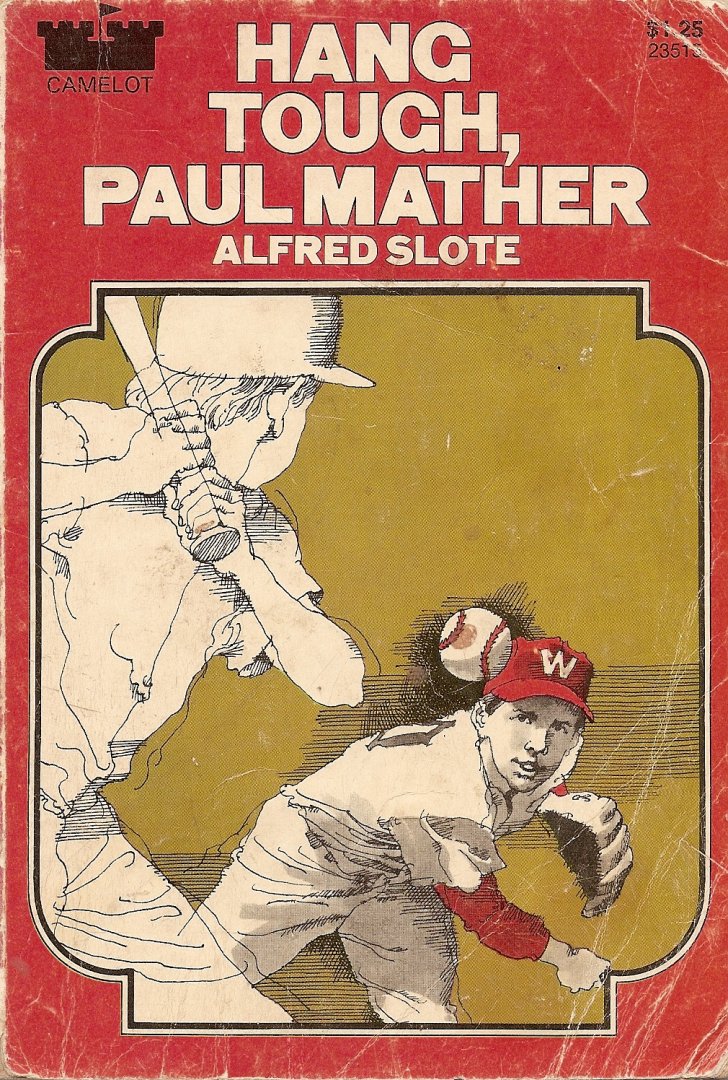
Early in Hang Tough, Paul Mather, three kids in little league uniforms stop on their way to a game to talk to two brothers who have just moved to town. The younger of the brothers starts bragging about his older brother’s pitching abilities. The three uniformed boys are skeptical, and when the older brother at first refuses to show them what he can do, they begin to mock him. He holds the ball they’ve handed to him. It feels good in his hands. Too good.
I was reading this scene on the subway this morning. I’d read it dozens of times before. Even so, I started to get tears in my eyes.
By this point in the novel, it has become clear that the older boy, Paul Mather, lives for baseball. But there have been hints of a serious medical problem. He’s not supposed to be playing any baseball, not until he gets permission from a new doctor, a specialist the family has moved across the country to be near.
I didn’t think of Hang Tough, Paul Mather during Jon Lester’s no-hitter two nights ago, but the connection between the real and fictional pitchers began to dawn on me the following morning as I listened to an interview with Lester’s father. Until that point I’d resisted the cancer-survivor angle because Lester himself expressed a desire to move beyond it. But Lester’s father marveling about a no-hitter his son threw in high school conjured images of the star pitcher as a kid, the kind of pitcher who might have thrown three no-hitters in little league, just like Paul Mather. And Lester’s father saying that the only thing that mattered was that his son was healthy and cancer-free made me think of Paul Mather’s father, whose melancholy, seemingly overprotective presence provides the novel with an ominous tone long before the word cancer is ever mentioned.
The most telling scene involving the father is the scene that I started describing above. In the end, Paul gives in to the temptation of the ball that feels so good in his hands. He starts pitching, just lobbing it at first, but soon he unleashes his entire awe-inspiring arsenal. He stops when his blazing pitches have made his catcher’s hand red and swollen, but he’s on the brink of going even farther, of walking off with the boys to their game. His father stops him by calling his name and telling him to come back inside. But what’s telling about the scene is that his father, according to a feeling Paul gets, had “been standing there for some time watching.”
He wants to protect his son, keep his son from hurting himself, yet he can see the joy his son is getting from playing the game he was made to play. Below is Paul himself describing that joy, from just after unleashing a breaking ball so nasty the catcher couldn’t handle it.
Monk came back with the ball. He held it. “I guess I’ve seen enough.”
“No, you haven’t,” I said.
I was bitten. It had been a long time since I had pitched, and I wasn’t going to stop now. I hadn’t wanted it to start up again, but now that it had started, I wanted it to go on and on and on . . .
I was beginning to feel in the groove. I was sweating. Sweat lubricates a pitcher. It gets all his moving parts working together. I was beginning to get a rhythm. It was like I hadn’t taken a year’s break at all. This was what it was all about. This was what you lived for and why you lived.
I first read the Hang Tough, Paul Mather when I was eight or nine years old. I’d read other baseball books before—in fact, other than Spiderman and Fantastic Four comics, baseball books were all that I ever read—but I hadn’t fallen in love with any of those books. Hang Tough, Paul Mather was the first. The story’s striking familiarity drew me in instantly. Like me, Paul Mather was one of two brothers. Like me, he was an outsider, part of a family that was new to their town. Like me, nothing was more important to Paul Mather than baseball. But the vital difference in our life stories was what drew me in even further. Here was a boy who lived for baseball who was having baseball taken away.
The book was so important to me that after I lost the copy I had as a child I bought another copy somewhere. But some years after that, my aunt, an elementary school librarian a few towns away from the town where I grew up, found a book with my name in it in a pile of books the library was giving away. The favorite book of my childhood had found its way back to me.
What was your favorite book as a child?


 Cardboard Gods
You must be logged in to post a comment.