
After stopping a losing streak for my imaginary Worcester Birds squad with his 5th straight win in his last 5 starts, Mark Fidrych’s win-loss record now stands at 15-6. Barring injury (always a distinct possibility with the brittleness embedded in the Strat-O-Matic card based on his 1977 season), Fidrych will get 9 more starts, i.e., 9 chances to collect the 5 wins needed to reach the 20-win plateau.
Who cares? It’s not real, for one thing, and for another, the 20-win mark isn’t seen the way it used to be. It used to be everything, and now it, or win totals in general, are viewed by many as a somewhat arbitrary echo of a pitcher’s performance, the decibal level of the echo leaning heavily on factors beyond the control of whatever original yawp was made by the pitcher. Jacob deGrom’s exploits in recent years, for example, revealed that judging his performance by his wins, or lack thereof, would be in the same neighborhood of illogical thinking as deeming Buddy Biancalana as a better shortstop than Ernie Banks because the former was, unlike the latter, a “World Series winner.”
But I still care about pitcher wins, at least in the context of this experiment. I want Fidrych to reach the 20-win milestone he fell just short of in 1976, and I think I’m also trying to prove, or at least suggest, that if Fidrych hadn’t gotten hurt, he would have gone on to have a good career.
There are some indications against this, chiefly Fidrych’s low strikeout rate, along with a very low batting average by opponents in 1976 against Fidrych on balls hit in play. Virtually every pitcher who has had a long, productive career has had, at the start of their careers, a significantly higher strikeout rate than Fidrych. (I am almost positive I learned this from the great baseball writer Rob Neyer, but I can’t find the article in which I remember him exploring vividly the disillusioning indications of Fidrych’s strikeout rate.) And batting average on balls hit in play seems to level off into a general average for all pitchers, a fairly clear indication that Fidrych was, in 1976 (and in Strat-O-Matic terms), getting all the rolls, something that surely would have leveled off as the years went on.
That’s why his 1977 Strat-O-Matic card is the better starting point for a “what if” experiment than his 1976 card. In 1977, his great control and his ability to limit the number of home runs he allowed are still in play, but more hits were falling in safely than they had the previous year. He wasn’t blowing anyone away. But could his approach—basically, throw strikes at the knees over the black edges of the plate—have carried him through a productive career if injuries hadn’t intervened?
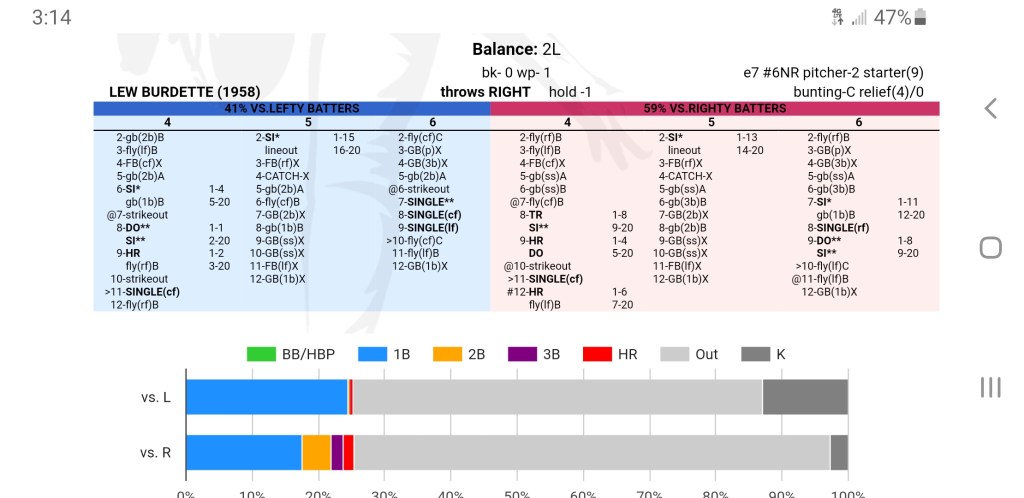
Indications thus far through my online Strat-O-Matic season are that he just might have pulled that off. Of course, some middle aged schmo’s online fantasy team results hardly rate as compelling evidence, but if you can take a leap of faith into considering them as such, the Strat-O-Matic card at the top of this page adds an interesting extension to that evidence. It’s a Strat-O-Matic representation of Lew Burdette’s 1958 season, one of Burdette’s best in a long, successful career, and it’s virtually identical to Fidrych’s 1977 card: no walks, no home runs, and a fair but not overwhelming number of hits.
Through his career, Burdette generally allowed more hits than innings pitched, didn’t strike out many guys, didn’t walk many guys, and didn’t allow a lot of home runs. He pitched like Mark Fidrych. This isn’t just a statistical mirroring. Burdette was, like Fidrych, exceedingly fidgety on the mound, often to the distraction of batters, and as he navigated his way through games he talked out loud to himself, which is what Fidrych was doing when people thought he was talking to the ball. Burdette stayed healthy, unlike Fidrych, and piled up 203 career wins, including two 20-win seasons.
The most fascinating element in playing “what if” with Mark Fidrych is that when injures were erasing him from the game, a tremendous core of young players was materializing on his team, the Tigers. What’s more, they were exactly what a pitcher who relies heavily on his defense would pray for: gold-glove-level fielding at every position in the middle of the field: Lance Parrish at catcher, Chet Lemon in centerfield, and Hall-of-Fame shortstop Alan Trammell and his (should be) Hall-of-Fame partner at second base, Lou Whitaker. The only up-the-middle defense equal to what Fidrych would have had behind him was that of the Big Red Machine.
Half of that Reds core, Joe Morgan and César Gerónimo, is backing Fidrych on my imaginary team, and they’re joined by fellow gold glove winners Thurman Munson and Larry Bowa. With this core behind him, a core similar to what he would had in Detroit had he been able to stay healthy, Fidrych’s record stands at 15-6.
Based on this, I see an alternative history taking shape, not for my benefit but because I wish it for Fidrych, who deserved more than what he got. I see several seasons, none of them as golden as 1976 but good and full of winning, sometimes deep into October.
Fidrych’s predecessor in statistics and Strat-O-Matic cards and twitches and self-babble, Lew Burdette, once won three games in a single World Series.
What if Mark Fidrych had gotten that far, with Whitaker and Trammell behind him? Is it so hard to imagine him winning and winning and winning?
***
Worcester Birds game notes:
- G112: L 6-0
- A reliever I don’t remember, Bruce Taylor, tosses 4 scoreless innings to help Dennis Martinez totally stifle the Birds.
- G113: L 5-2
- Another weak offensive showing, and Lee struggles, dropping to 2-7.
- G114: L 9-0
- The team follows its return to first in its previous series with its weakest series of the year, getting outscored 20 to 2 (and dropping like a rock out of first).
- G115: L 4-1
- Stagnant hitting (now with 3 runs in 36 innings) wastes a decent start by Tiant.
- G116: W 4-3 (Fidrych 15-6)
- Fidrych stops the losing streak with 1 earned run in 6 innings, notching his 5th win in his last 5 starts. Singleton homers and drives in 2.
- G117: W 9-5
- Bostock leads a revived offense with 3 runs, 2 hits, and 4 RBI. Campbell hurls 4 scoreless innings for save.


 Cardboard Gods
You must be logged in to post a comment.